Dr. Tomlinson - photo by Jay Paul (Education Week)
Basics
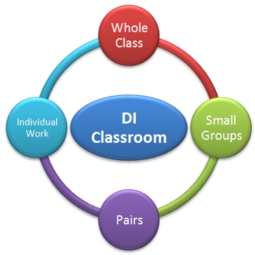
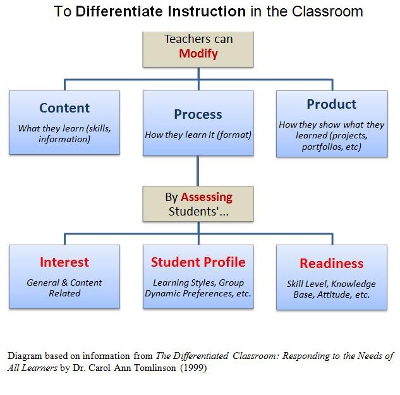
The ideas and structures of Differentiated Instruction, or DI, that this site are based on stem from the work of Dr. Carol Ann Tomlinson, who is a pre-eminent expert on DI. As Tomlinson puts it, “differentiating instruction is an approach to teaching that advocates active planning for and attention to student differences in classrooms, in the context of high quality curriculum.” As opposed to individualized instruction, which can be overwhelming, and the common teaching to “the middle” approach, DI is more comparable to the old one-room-schoolhouse, where instructors used to employ many different formats to teach to students of widely diverse abilities and backgrounds. In this way, a more flexible approach using many different formats of instruction (whole class, small groups, pairs, etc.) for all students is what DI supports. Tomlinson’s lists in her book, How to Differentiate Instruction in Mixed-Ability Classrooms, the following descriptives of DI:
- Continually assesses students using multiple forms of assessment to find what works best for students
- Blends many forms of instruction (whole class, group, and individual instruction) to help students learn
- Flexible, dynamic, and reactive strategies of instruction to match “what works best” for the class and individual learners
- Uses flexible groupings to promote collaboration and allow students to use different strengths and help other students learn
- Provides appropriate support for each student (“scaffolds”) to be challenged, but not overwhelmed